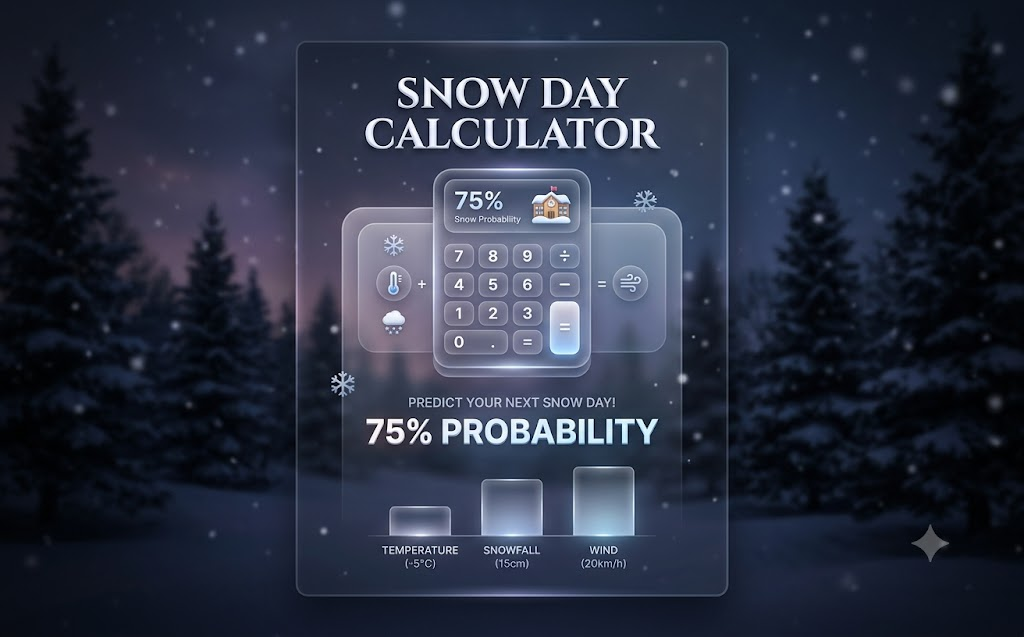
Snow Day Calculator
A Snow Day Calculator is a popular online tool that predicts the likelihood of schools closing because of snowfall or severe winter weather. Students, parents, and teachers often use it to estimate whether a snow day is likely before an official announcement. While it is not a guaranteed predictor, it combines weather forecasts, historical trends, and local conditions to provide a probability score. Understanding how it works can help users set realistic expectations during the winter season.
What Is a Snow Day Calculator?
A Snow Day Calculator is a digital prediction tool designed to estimate the chance of school closures caused by snow, ice, or other dangerous winter conditions. Users typically enter their location, school district, or ZIP code to receive a forecasted percentage. The calculator analyzes multiple weather factors to determine the likelihood of classes being canceled.
Many people check Snow Day Calculator the evening before a storm. Although school officials make the final decision, the predictions often provide a useful preview. The calculator is especially popular in regions where heavy snowfall regularly disrupts transportation and outdoor activities.
How Does a Snow Day Calculator Work?
A Snow Day Calculator gathers weather information from forecasting services and processes it through mathematical models. It considers expected snowfall totals, temperature, wind speed, ice accumulation, and road conditions. Some advanced versions also analyze historical school closure patterns in specific districts.
The tool compares current weather forecasts with previous situations that resulted in school cancellations. By evaluating these similarities, it generates a probability score that estimates the chance of a snow day. This percentage is intended as guidance rather than a guarantee.
Factors That Affect Snow Day Predictions
Several important variables influence the results produced by a snow day prediction tool. Snowfall amount is usually the biggest factor because deeper snow creates hazardous travel conditions. However, temperature also matters since freezing conditions can create icy roads even with light snowfall.
Wind speed, visibility, freezing rain, and overnight weather changes also contribute to predictions. Rural districts often have different closure thresholds than urban areas due to road maintenance capabilities. School transportation systems and local government decisions further affect the final outcome.
Why Students Love Snow Day Calculators
Students enjoy checking snow day predictions because they add excitement before winter storms. The possibility of staying home from school creates anticipation, especially when weather forecasts predict significant snowfall. Many students compare results with classmates and discuss their chances throughout the day.
The calculator also encourages children to pay attention to weather forecasts and understand winter conditions. Instead of simply hoping for a day off, they learn how different weather elements influence school safety decisions and transportation concerns.
Why Parents Use Snow Day Predictions
Parents often rely on snow day predictions to prepare childcare arrangements and work schedules. Knowing there is a high chance of school closure allows families to plan ahead rather than making last-minute decisions early in the morning.
Parents can also prepare emergency supplies, adjust commuting plans, and organize indoor activities for children. Even if the prediction is not perfect, having advance notice helps reduce stress during severe winter weather events.
Benefits for Teachers and School Staff
Teachers and school employees also monitor snow day forecasts to prepare lesson plans and adjust classroom schedules. If a closure appears likely, educators may organize remote learning materials or postpone important assignments until students return.
School administrators use official weather reports rather than public calculators, but prediction tools still provide general awareness. Staff members can prepare transportation plans and communicate more effectively with students and parents during winter storms.
Accuracy of Snow Day Calculators
Many users wonder how accurate these prediction tools really are. Their accuracy depends on the quality of weather forecasts and the algorithms used. Since weather conditions can change rapidly, predictions become more reliable closer to the expected snowfall event.
No calculator can perfectly predict school closures because local administrators consider many additional factors. Road treatment, bus routes, emergency services, and district policies all influence the final decision. Therefore, users should treat predictions as estimates instead of confirmed outcomes.
Weather Data Used in Calculations
Modern prediction systems rely on detailed meteorological information from weather services. Forecast models estimate snowfall totals, precipitation timing, temperature changes, and wind conditions throughout the storm. These forecasts are updated regularly as new weather information becomes available.
Some calculators also include elevation, regional climate patterns, and historical snowfall records. Combining multiple data sources improves prediction quality and helps generate more realistic probability scores for different communities.
Snowfall Amount and Its Importance
The expected depth of snowfall plays a central role in determining school closure probabilities. Light snowfall often has little effect if roads remain clear, while heavy snow can make travel dangerous for buses and personal vehicles.
Different regions have different snowfall thresholds. Areas accustomed to frequent snow may remain open despite several inches, while places with limited snow removal equipment may close schools after only a small accumulation.
Ice and Freezing Rain Matter Too
Snow is not the only winter hazard considered in predictions. Freezing rain and ice storms often create more dangerous travel conditions than snow alone. Thin layers of ice can make roads extremely slippery even when snowfall is minimal.
Ice accumulation also increases the risk of power outages and fallen tree branches. Schools frequently close during severe ice storms because transportation becomes unsafe for students, staff, and emergency responders.
Regional Differences in School Closures
Snow day decisions vary widely across different regions. Northern communities with regular snowfall usually have well-equipped snow removal crews and buses designed for winter travel. Schools in these areas often remain open despite significant snow.
Southern regions that rarely experience snow may close schools quickly because roads, equipment, and drivers are less prepared for winter weather. Understanding regional differences helps explain why identical snowfall amounts produce different closure decisions.
Tips for Using a Snow Day Calculator
Check the calculator several times before the expected storm because weather forecasts change frequently. Evening predictions often become more accurate overnight as meteorologists receive updated weather information. Comparing multiple forecast sources can also provide a better overall understanding.
Always wait for official announcements from your school district before making final plans. A prediction tool is helpful for preparation, but only school administrators can officially confirm closures, delays, or schedule changes.
Common Myths About Snow Day Predictions
Some people believe a high prediction percentage guarantees a school closure. In reality, even a ninety percent probability does not ensure classes will be canceled because unexpected weather changes may improve travel conditions.
Another common myth is that snowfall alone determines closures. School officials evaluate many additional factors, including road safety, transportation availability, emergency services, and weather expected during pickup and dismissal times.
Technology Behind Modern Prediction Tools
Advances in computer technology have greatly improved weather prediction systems. Machine learning, advanced forecasting models, and large weather databases allow calculators to process information faster and generate more accurate estimates than earlier methods.
These systems continuously update predictions as new weather observations become available. Improved satellite imagery, radar technology, and computer simulations help forecast winter storms with increasing precision.
Preparing for a Possible Snow Day
Families should prepare before winter storms regardless of prediction percentages. Stocking essential groceries, charging electronic devices, and ensuring adequate heating supplies can make unexpected closures more comfortable and less stressful.
Parents should also discuss emergency plans with children and monitor official communication channels from schools. Preparing in advance allows everyone to stay safe if severe weather develops more quickly than expected.
Conclusion
A Snow Day Calculator is a fun and practical tool that estimates the likelihood of school closures during winter weather. By analyzing snowfall forecasts, temperatures, road conditions, and historical data, it provides useful guidance for students, parents, and educators. Although no prediction can replace official school announcements, these calculators help families prepare ahead of time and better understand how weather affects daily life. Used wisely, they make winter planning easier while adding a little excitement whenever snow is in the forecast.
About the Author