Cash on Delivery Still Dominates Tunisian Ecommerce
Ask a Tunisian online seller how customers pay, and one answer comes up first: cash on delivery. Years into the growth of local ecommerce, it remains the default way Tunisians buy online.
For merchants, that reliance cuts both ways. Cash on delivery brings in cautious buyers who would not pay any other way, but it carries costs that quietly eat into margins. This guide looks at why it still dominates, what it really costs, and how stores can reduce their dependence on it.
Table of Contents
• How Common Is Cash on Delivery in Tunisia
• Why Tunisian Buyers Still Prefer It
• The Hidden Costs for Merchants
• How COD Shapes the Whole Business
• Reducing Dependence on COD
• The Role of Local Digital Payments
• Finding the Right Balance
• FAQs
1. How Common Is Cash on Delivery in Tunisia
Cash on delivery is not just popular in Tunisia. It is the norm. Estimates vary by source, but they all point the same way.
Recent buyer surveys put it at more than half of online shoppers, while some government figures place cash on delivery at over eighty percent of online transactions. Either way, it is the clear majority.
Compared with a global average in the single digits, Tunisia sits at the far end of the scale. Few markets lean on cash at checkout as heavily as this one.
That dominance is the backdrop every Tunisian online store has to work with, whether it likes it or not.
This did not happen by accident. Tunisia is still a largely cash-based economy, card ownership for online use is limited, and the habits formed offline carry straight into ecommerce.
2. Why Tunisian Buyers Still Prefer It
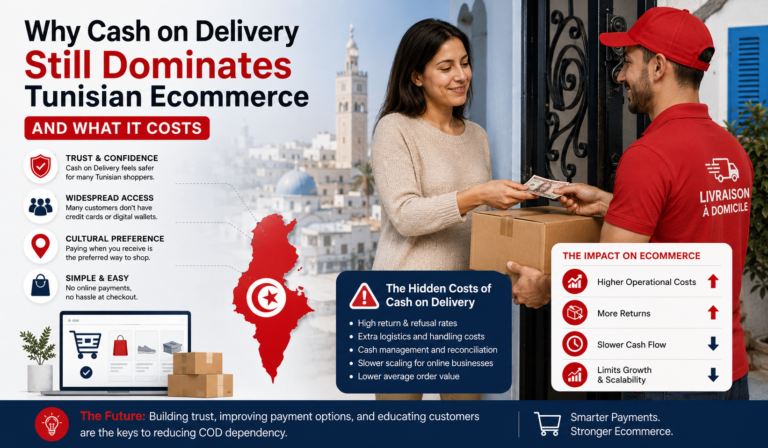
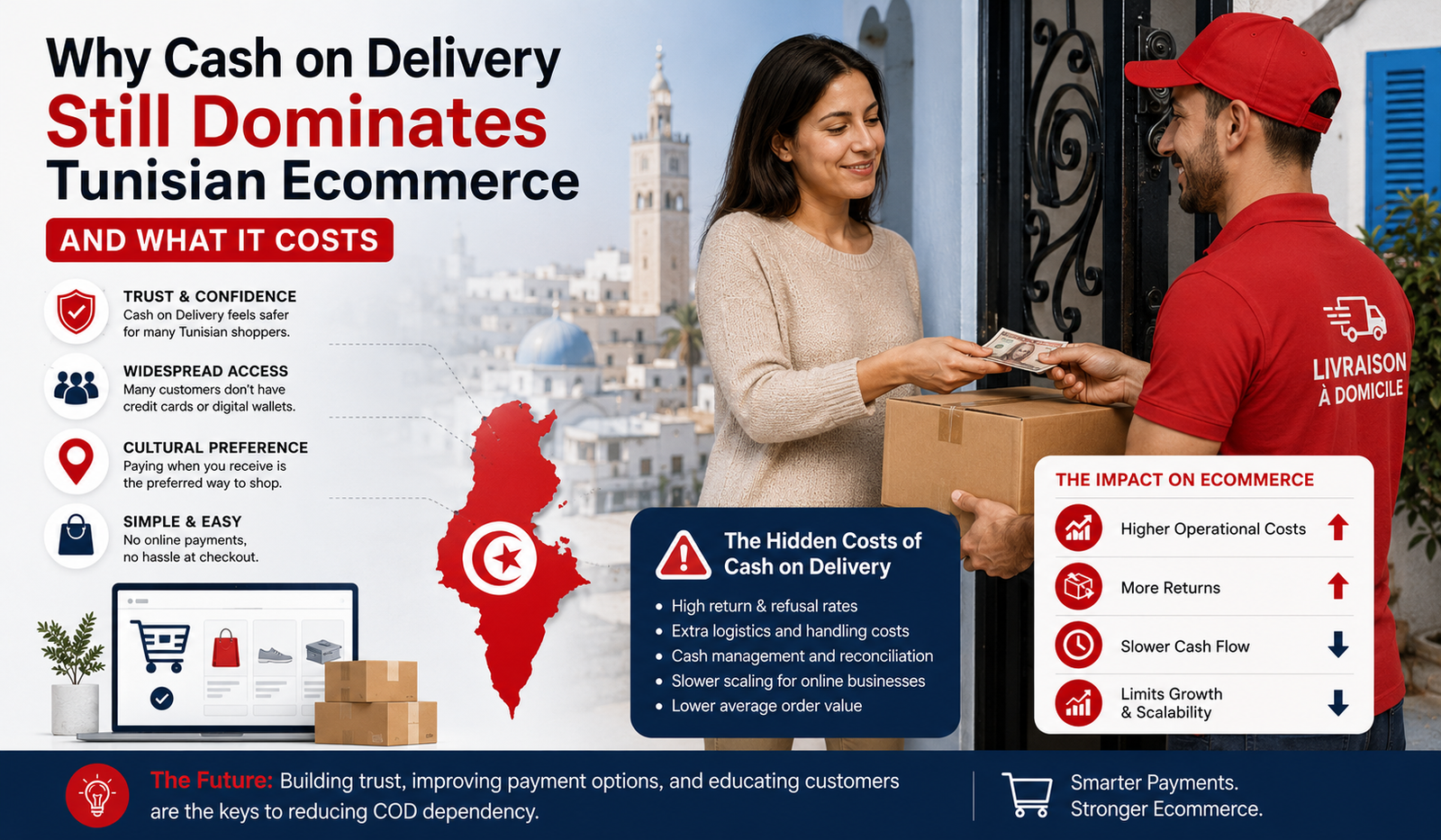
The preference is rooted in trust, not habit alone. Surveys consistently find that a lack of trust in online payment is the top reason Tunisians avoid paying in advance.
Buyers want to see and hold the product before parting with money. Concerns about quality, delivery reliability, and the difficulty of getting a refund all push them toward paying at the door.
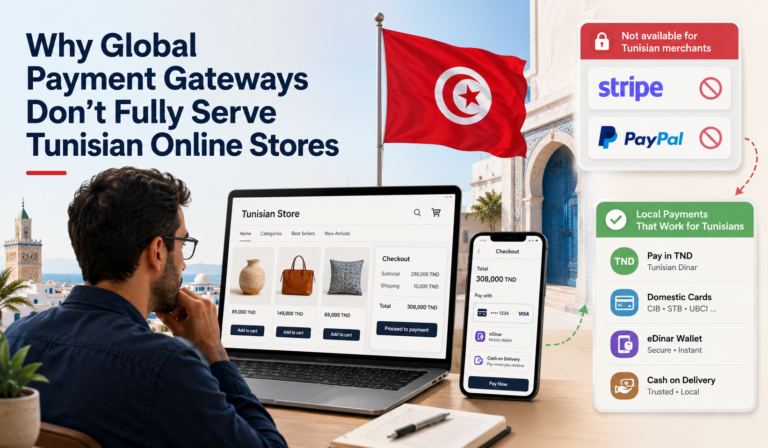
There is a structural reason too. Because global gateways like Stripe and PayPal are largely unavailable, and local cards are limited by currency controls, many buyers do not have a convenient prepaid option they trust.
Cash on delivery fills that gap. It lets people buy online without taking on the risk they associate with digital payment.
Word of mouth reinforces the habit. When friends and family all pay on delivery, it becomes the expected way to shop, and a store that pushes too hard against it can seem less trustworthy rather than more.
3. The Hidden Costs for Merchants
Cash on delivery keeps sales flowing, but it is far from free. The costs are simply less visible than a card fee:
• Failed deliveries: buyers refuse parcels at the door, and the merchant absorbs shipping both ways with nothing to show for it.
• Return to origin: high refusal rates mean stock comes back, tying up inventory and staff time.
• Delayed cash flow: money arrives only after the courier collects and remits it, sometimes weeks later.
• Reconciliation load: matching cash collected by couriers to individual orders is manual and error-prone.
Each of these chips away at margin. A sale that looks profitable on paper can lose money once a refused delivery and its return shipping are counted.
For thin-margin categories, a run of failed COD orders can erase the profit earned on the successful ones.
Consider a simple case. A store ships an order worth thirty dinars, the buyer refuses it at the door, and the merchant pays courier fees in each direction. The order that promised a profit ends as a net loss, before counting the staff time spent processing the return.
4. How COD Shapes the Whole Business
The effects go beyond individual orders. Heavy reliance on cash on delivery shapes how a store operates.
Cash flow becomes lumpy and hard to predict, which makes restocking and marketing spend harder to plan with confidence.
Automation suffers. A checkout that ends in cash cannot trigger the clean, instant confirmation that digital payment allows, so fulfilment and accounting stay manual.
Growth hits a ceiling. Scaling a COD-heavy operation means scaling refusals, returns, and cash handling right along with sales.
The pattern shapes hiring and tools as well. Teams end up built around phone confirmations, cash counting, and courier follow-ups rather than the systems a digital-first store would rely on.
5. Reducing Dependence on COD
Merchants cannot force buyers off cash on delivery, but they can nudge behaviour over time:
• Build trust signals: clear return policies, reviews, and reliable delivery reduce the fear that drives COD.
• Offer prepaid incentives: a small discount or free shipping for paying online shifts some buyers across.
• Confirm orders: a quick verification step, often by phone or messaging, cuts fake and impulse COD orders.
• Make digital easy: the more familiar and local the online option, the more buyers will try it.
The goal is not to abolish COD overnight. It is to grow the share of prepaid orders steadily, so the business becomes less exposed to the costs above.
Small shifts compound. Moving even a fifth of orders from cash to prepaid noticeably reduces failed deliveries and smooths out cash flow across the month.
The confirmation step is worth singling out. In a COD market, a quick check before dispatch is one of the most effective ways to cut wasted deliveries, and it doubles as a natural moment to offer a prepaid option.
6. The Role of Local Digital Payments
For buyers to move away from cash, the alternative has to feel local and safe. This is where Tunisia’s own digital methods matter.
Local card payments in dinar, wallets like Flouci, and other domestic options give buyers a prepaid route that does not depend on foreign platforms they cannot use.
As these methods spread, the digital share of Tunisian ecommerce has been rising. The shift is gradual, but it is real.
None of this replaces cash on delivery outright. It gives hesitant buyers a first, low-risk taste of paying online, which is how habits change over time.
Offering these options well, in dinar and with a familiar checkout, is the practical way to give COD-wary buyers something they will actually use. Mapping the right local payment methods for Tunisian stores is the first step.
7. Finding the Right Balance
The realistic aim for most Tunisian stores is a blend: keep cash on delivery for the buyers who need it, while making prepaid options easy for everyone else.
That means offering several methods at once, cards, wallets, and COD, so each buyer picks what they trust.
Running that many options separately is a burden. A payment mediation platform connects a store to multiple local providers through one integration, with reporting in a single view. Platforms such as UnumPay take this approach for Shopify stores, which makes offering a fuller set of Tunisia ecommerce payment options manageable.
Over time, the mix shifts. As buyers grow comfortable with digital payment, the costly COD share shrinks and the business gets healthier for it. For stores rethinking their checkout options for Tunisian buyers, that transition is worth planning deliberately.
FAQs
How common is cash on delivery in Tunisia? It is the majority of online orders, with estimates ranging from over half of buyers to more than eighty percent of transactions.
Why do Tunisians prefer cash on delivery? Mainly a lack of trust in online payment, plus limited access to prepaid options they find convenient.
What does COD cost merchants? Failed deliveries, returns, delayed cash flow, and manual reconciliation, which together erode margins.
Can a store stop offering COD? Rarely without losing sales. The better path is growing prepaid orders while keeping COD available.
What helps move buyers to digital payment? Trust signals, prepaid incentives, order confirmation, and easy, local digital methods.
The Bottom Line
Cash on delivery dominates Tunisian ecommerce because it solves a trust problem that digital payment has not yet fully answered. That makes it essential, but also expensive.
The smart response is not to fight COD, but to balance it: keep it for those who need it, and make local digital payment so easy that more buyers choose it on their own.
As that balance tips toward prepaid, Tunisian stores spend less on failed deliveries and cash handling, and more of every sale reaches the bottom line.
About the Author