The click is dying — and that may be the best thing to happen to marketing in a decade. A field guide to the zero-click world.
I want to open with a confession that would have gotten me laughed out of a marketing meeting three years ago: the click is dying, and I am not even slightly sad about it.
For most of my career, “digital marketing” meant one quietly desperate activity — manufacturing clicks. We optimised headlines to be clicked, built funnels to be clicked through, bid on keywords to win the click, and then measured our entire professional worth by how many strangers we had persuaded to tap a blue link. The click was the currency, the KPI, the thing we put in the deck. And now, in 2026, the click is going the way of the fax machine: still technically alive, increasingly beside the point.
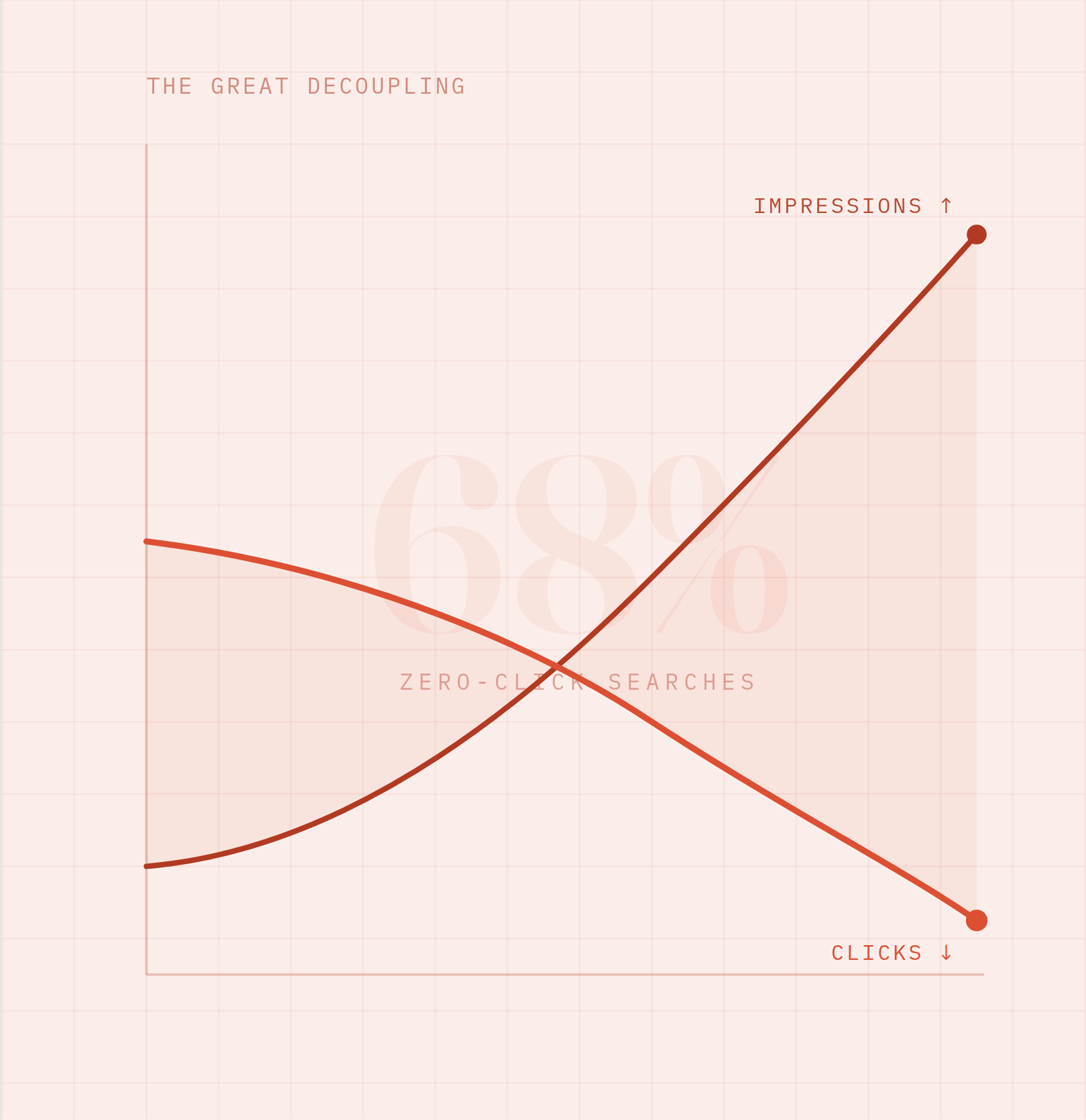
Let me give you the number that reorganised how I think about my whole job. According to SparkToro’s analysis of Similarweb clickstream data, in the first four months of 2026, 68% of Google searches ended without a single click. Not 68% of some niche segment — 68% of everything. Two years earlier that figure was around 60%, which means we just lived through the fastest acceleration of clicklessness in a decade. Google has quietly turned itself from a doorway to the web into a walled garden where the answer lives on the results page and you are gently discouraged from ever leaving.
| 68%of Google searches in early 2026 ended without a single click — up from ~60% two years earlier.SPARKTORO · SIMILARWEB CLICKSTREAM |
If you make your living sending people to a website, that sentence should make the back of your neck prickle a little.
The machine that ate the click
The culprit has a friendly name and a slightly menacing effect: AI Overviews. You have seen them — that confident little paragraph of AI-generated answer that sits at the top of the search results, summarising what six websites spent years writing, so that you never need to visit any of them.
The data on their impact is genuinely startling, and I have spent enough late nights in analytics dashboards to know when a number is real and when it is a vendor trying to scare me into a contract. These are real. Ahrefs found that when an AI Overview appears, the number-one organic result can lose around 50 to 58% of its click-through rate. Read that again: you can do everything right — rank first, perfect your titles, earn the backlinks, win the SEO game on its own terms — and still lose half your clicks to a robot paraphrasing you for free above your own listing.
| 50–58%of click-through the #1 organic result can lose the moment an AI Overview appears above it.AHREFS |
Pew Research, in a study tracking nearly 69,000 actual searches rather than survey opinions, found that when an AI Overview is present, only about 1% of users click the citation links inside it, and roughly 26% simply end their browsing session entirely — answer received, tab closed, goodbye. Bain & Company put the commercial consequence bluntly: organic web traffic has declined an estimated 15 to 25% across many sectors, and 80% of consumers now rely on AI-generated results for at least 40% of their searches.
And then there is the figure that should be tattooed on the inside of every content marketer’s eyelids, courtesy of Ahrefs: 99.9% of informational keywords now trigger an AI Overview. If your strategy was “write helpful how-to content and watch the traffic roll in,” I am sorry to be the one to tell you, but Google has decided to keep that traffic for itself.
| 99.9%of informational keywords now trigger an AI Overview. Helpful how-to traffic is the first thing Google keeps.AHREFS |
The carnage is not theoretical. Business Insider reportedly lost around 55% of its organic traffic. Forbes and HuffPost saw declines near 50%. Chegg lost about half its non-subscriber traffic and was so unamused it filed an antitrust lawsuit. These are not sloppy operations that forgot how to do SEO. These are giants who played the old game flawlessly and watched the rules change mid-match.
My favourite plot twist: where AI got bored
Here is the part that makes me laugh, because the universe has a sense of humour about marketing.
Google originally rolled AI Overviews into e-commerce and shopping queries too. Then it quietly pulled them back. Why? Because the AI answers were not converting into sales. Ahrefs data shows AI Overviews now appear on only about 3.2% of e-commerce queries, down from roughly 29% at the start. Google will happily cannibalise your blog traffic about “how to descale a coffee machine,” but the moment there is actual money on the table — “best espresso machine under $500” — it suddenly remembers it would rather you saw the shopping ads.
There is a lesson buried in that little act of corporate self-interest, and it is the most important strategic idea I can give you: commercial intent still clicks; idle curiosity does not. The searches that survive the AI cull are the ones close to a purchase, close to a local decision, close to a real human need that a summary cannot satisfy. Informational top-of-funnel content — the backbone of a decade of content marketing — is precisely what is being hollowed out. The bottom of the funnel is, for now, relatively safe. Local searches are largely safe. Shopping is safe. “How does X work” is toast.
Commercial intent still clicks; idle curiosity does not.
So no, digital marketing is not dead — it changed jobs
Every few months somebody publishes a dramatic obituary for digital marketing, and every few months they are wrong in the same way. Digital marketing is not dying. It is being violently reassigned. The job used to be get the click. The job is now be the answer.
The job used to be get the click. The job is now be the answer.
Ahrefs has a lovely term for what is happening: the Great Decoupling. Impressions keep rising — your brand is being seen, referenced, read into AI summaries — while clicks flatten or fall. Visibility and traffic, once joined at the hip, have filed for divorce. The old measurement framework, where a session in Google Analytics equalled a unit of marketing success, is now actively misleading you. You can be more influential than ever and watch your traffic graph slope downward at the same time.
This is why I have stopped talking to clients about traffic as the goal and started talking about presence at speed — what I think of as the speed-traffic era. The winners are not the businesses generating the most clicks. They are the businesses that show up fastest and most consistently in the places where decisions actually get made now: inside the AI Overview as a cited source, inside ChatGPT and Perplexity answers, on the first screen of a local pack, in a LinkedIn feed, in a Reddit thread the model scraped last week. Speed of presence across surfaces beats volume of clicks to one website.
And here is a genuinely encouraging counter-fact to balance the doom: the clicks that do survive are worth dramatically more. Multiple studies suggest that visitors who arrive after reading an AI summary or being recommended by an AI tool convert at 1.2 to 5 times the rate of traditional organic visitors. They arrive pre-qualified, having already cleared the scepticism barrier, because a machine they trust just vouched for you. Fewer visitors, hotter visitors. A business that previously got 10,000 monthly visitors converting at 2% and now gets 4,000 converting at 6% is not a casualty — it is a business that quietly got more efficient while its traffic chart frightened it.
What I actually do about it now
Let me be practical, because gloomy think-pieces without a to-do list are just expensive anxiety.
I optimise to be cited, not just to rank. This has a name now — Answer Engine Optimization, or AEO — and it is the real successor to SEO. The mechanics that get a brand pulled into an AI Overview are not mysterious: clear, direct answers to real questions; structured data and schema markup so machines can parse you; and, above all, original material a model cannot get anywhere else — proprietary data, real benchmarks, first-hand research, a genuine point of view. Generic content that merely restates the consensus is exactly what the AI replaces. Distinctive content is what it quotes. Seer Interactive found that brands cited inside an AI Overview earn around 35% more organic clicks and 91% more paid clicks than uncited brands on the same query. Being the source is the new being on page one.
I treat the website as the influence engine, not the destination. Even as traffic falls, the content you publish is what feeds the AI answers, the knowledge panels, the zero-click features. You still need to write the support article so the AI gets your product right. You are no longer publishing to earn the visit; you are publishing to shape what the machine says about you to the people who never visit. That is a stranger job than the one I trained for, but it is the job.
I diversify off the rented platform on principle. Roughly 85% of B2B buyers, Bain found, purchase from a “day-one vendor list” — the shortlist they had in their head before they searched anything. If the buying decision is increasingly made before the search even happens, then pre-search familiarity — brand, reputation, the LinkedIn post they half-remember, the newsletter they actually open — is the whole game. So I move weight toward owned channels I control outright: email, community, a recognisable point of view shared natively on social rather than as a link-dump that the algorithm will bury.
I change what I measure before the dashboard lies to me. Sessions and organic clicks no longer tell the full story, and clinging to them will make a healthy business look sick. I now track AI-citation visibility (literally asking the models what they know about a brand), revenue per visitor, and pipeline from pre-search demand. Vanity metrics were always seductive; in the zero-click era they are actively dangerous, because they can crater while the business gets healthier, or hold steady while it quietly rots.
Not all zero-click is created equal
Before you spiral, let me introduce a distinction that took me embarrassingly long to appreciate: there is good zero-click and bad zero-click, and treating them as the same thing is how marketers talk themselves into despair.
Bad zero-click is the informational query where a robot strip-mines your hard-won content, answers the user, and sends you nothing — no click, no awareness, no credit. That one genuinely hurts, and if your whole model depended on it, you have real work ahead. But good zero-click is the moment someone searches your brand name and the results page confirms, instantly and authoritatively, that you exist, you are legitimate, and here is your address and your rating. That is free brand reinforcement. It is the AI summarising a question and citing you as the trusted source, planting your name in the mind of a buyer who will come back through the front door later, directly, with intent. Counting that as a “loss” because it didn’t produce a tracked click is like a shopkeeper mourning that someone walked past the window, admired the display, and decided to come back on payday.
The discipline, then, is to stop counting all unclicked impressions as failure and start asking which ones built brand and which ones merely fed the machine for nothing. One is an asset. The other is a leak. They look identical in a traffic dashboard, which is exactly why the traffic dashboard is no longer enough.
Where this is heading (so you can stop being surprised)
I am wary of forecasts, because the AI era has made fools of confident people at a remarkable rate. But the trajectory here is consistent enough across independent sources that I am willing to point at it.
Gartner’s read is that traditional search volume drops meaningfully as AI chatbots absorb query share, with organic traffic to websites potentially declining 50% or more by 2028. Semrush has floated that AI-powered search could overtake traditional search outright within a couple of years. The German market gives us a preview of the scale: one analysis put the loss from AI Overviews at a staggering 265 million clicks per month for German websites alone. And AI Overviews, already live across much of Europe, are expected to be joined by Google’s fuller “AI Mode” — where as many as 93% of searches reportedly end without a click — across European markets through 2026, regulatory timing permitting.
I do not share these to frighten you into a contract, the way half the SEO industry currently does. I share them so that when your traffic chart does the thing, you greet it as a structural weather pattern you forecasted, rather than a personal catastrophe you caused. There is enormous professional calm in expecting the storm. The marketers who panic in 2026 are the ones who believed, against all evidence, that the click was eternal.
The uncomfortable, liberating truth
Digital marketing went out of style the way most things go out of style — not with a funeral, but with everyone slowly realising the old version looks a bit embarrassing now. Bidding for clicks on informational keywords in 2026 has the same energy as buying a billboard on a road they just closed.
What replaces it is faster, weirder, and honestly more interesting. It rewards the brands with something genuinely worth citing and punishes the ones who spent a decade producing competent, forgettable, search-bait sludge. The machine ate the filler first. Good. The filler was never the point.
I tell my clients this with a straight face and a small, sincere smile: stop trying to win the click. The click is leaving. Win the answer — be the thing the machine quotes, the brand on the day-one list, the source the model trusts — and you will discover that you needed far fewer clicks than you thought to build something real. The traffic era is ending. The presence era has started. I would rather be early to it than write its obituary in 2028 wondering where everyone went. ■
About the Author