Global payment gateways
For Tunisian entrepreneurs launching an online store, the instinct is often to reach for the payment names everyone knows: Stripe, PayPal, and the other global gateways that power e-commerce across much of the world. On paper, these platforms promise instant card acceptance and a global customer base. In practice, Tunisian sellers quickly discover that the most recognised international gateways were never built with their market in mind.
The payment gateway limitations Tunisia faces are not a matter of one provider having a temporary outage or a missing feature. They are structural, rooted in currency rules, banking access, and regulatory frameworks that global platforms have not been able to operate within. This post explains why international gateways fall short for Tunisian online stores, where the gaps appear, and what a payment setup that fits the local reality actually looks like.
Table of Contents
• The Global Gateway Assumption
• Why Stripe Is Not Available to Tunisian Sellers
• The PayPal Problem: Registered but Restricted
• Currency Controls: The Root of the Limitation
• Where the Gaps Show Up at Checkout
• Building a Setup That Reflects How Tunisians Pay
• FAQs
1. The Global Gateway Assumption
Much of the advice written for new online sellers assumes a baseline that does not exist in Tunisia. Guides recommend connecting Stripe in minutes or enabling PayPal checkout as if availability were universal. This assumption breaks down at the border. Global payment gateways decide where they operate based on local acquiring banks, currency convertibility, and regulatory clarity – and Tunisia sits outside the set of markets where those conditions are met.
The result is a gap between what merchants expect and what they can actually use. A Tunisian seller can read the same international playbook as a merchant in France or the United States, follow every step, and still find the recommended tools closed to them. Understanding why this happens is the first step toward building something that works.
2. Why Stripe Is Not Available to Tunisian Sellers
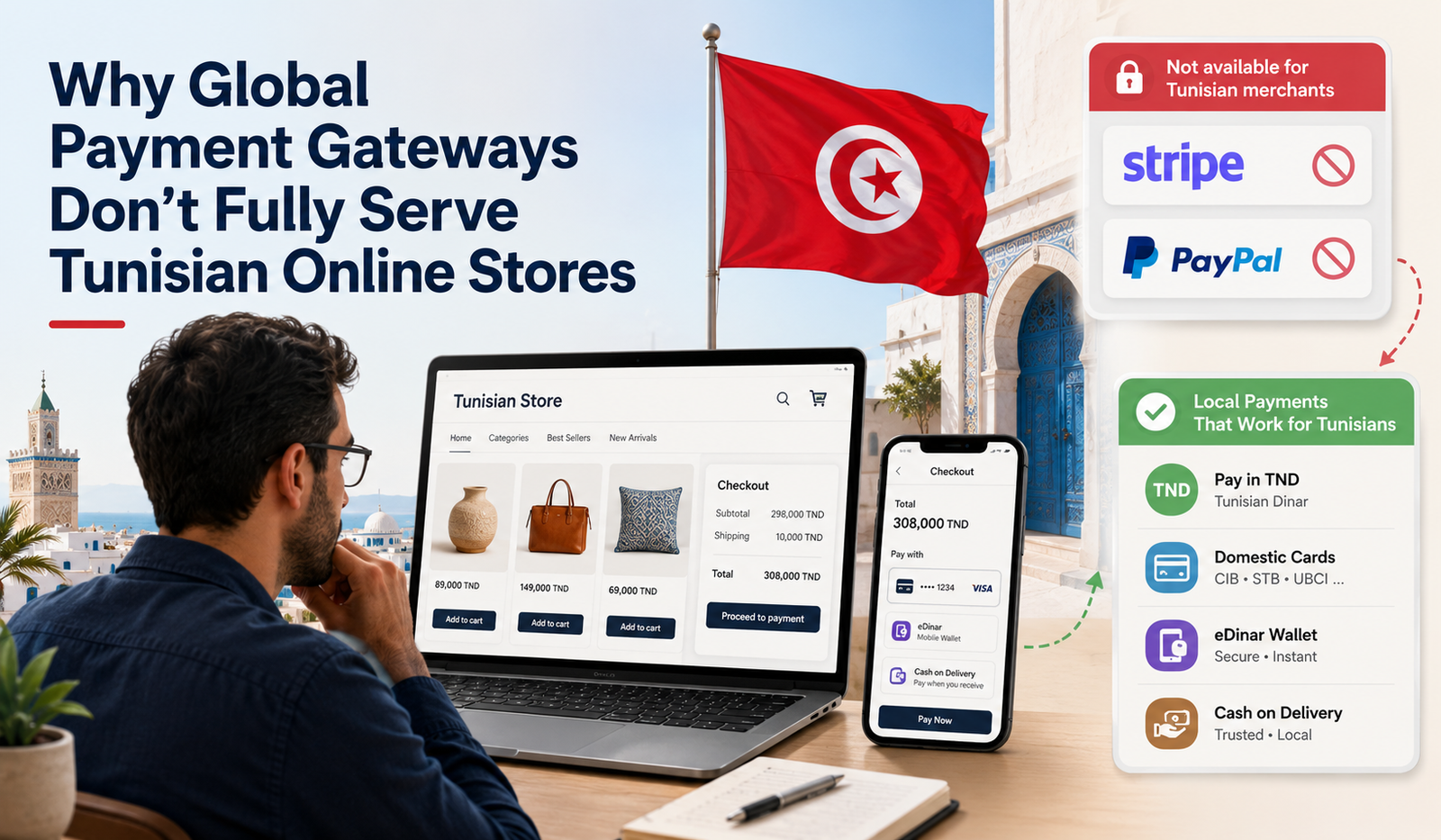
Stripe availability is determined by where a business is legally registered, not where its customers are. As of 2026, Stripe supports businesses in a limited set of markets – roughly forty-six countries – and Tunisia is not among them. A Tunisian-registered business cannot create a standard Stripe account or process payments through the platform directly.
This is the clearest example of the international gateway gaps Tunisia contends with. The workarounds that circulate online, such as registering a company abroad or opening a foreign bank account, are real, but they add legal cost, administrative burden, and tax complexity that most small and mid-sized Tunisian stores cannot justify. For a merchant who simply wants to sell to Tunisian and regional buyers, incorporating overseas to access one gateway is a disproportionate response to the problem.
3. The PayPal Problem: Registered but Restricted
PayPal is often assumed to be the universal fallback, and Tunisian users can indeed register an account. The difficulty begins the moment they try to use it for business. A Tunisia-based PayPal account cannot reliably receive funds and withdraw them to a local bank, and PayPal does not support the Tunisian dinar.
The PayPal Tunisia limits run deeper than receiving. Because an ordinary Tunisian bank card is approved only for dinar transactions and blocked from spending in foreign currency, the account often cannot be used to pay internationally either. For an online store that needs to collect money from customers and settle it locally, an account that cannot dependably receive or withdraw is not a payment solution. It is a registration with little practical function.
4. Currency Controls: The Root of the Limitation
None of this is really about any single provider. It traces back to Tunisia’s foreign-exchange framework. For decades, the country operated under tight currency controls: the dinar was not fully convertible, residents faced strict limits on holding foreign currency, and foreign earnings generally had to be converted into dinars.
These rules were designed to protect limited foreign-currency reserves, but they left platforms built on the free cross-border movement of money without a framework to operate in fully. Reform is underway, and recent steps such as foreign-currency accounts for residents signal a shift. For now, though, currency controls remain the underlying reason global gateways treat Tunisia as a market they cannot fully serve. Any merchant evaluating their options needs to plan around the rules as they stand today, not as they may become.
5. Where the Gaps Show Up at Checkout
For a Tunisian online store, the limitations of global payment gateways are not abstract. They appear at the most decisive moment, checkout, in several ways:
• No domestic card acceptance: global gateways that cannot operate locally leave merchants unable to accept the everyday Tunisian bank cards that most domestic buyers carry.
• No local payment methods: international platforms rarely support the wallets and local schemes Tunisian buyers use, from the Flouci wallet to the unified national mobile-payment label.
• Currency mismatch: a gateway that does not handle the dinar forces awkward conversions that confuse buyers and erode trust at the point of sale.
• Settlement friction: even where an international payment can be captured, getting those funds into a Tunisian bank account in usable form is slow and uncertain.
Each gap is a point where a potential sale can quietly disappear. A buyer who does not see a familiar, dinar-denominated payment option often simply leaves.
6. Building a Setup That Reflects How Tunisians Pay
The practical path for Tunisian stores is not to force a global gateway to fit, but to build around how customers in the market actually pay. That means prioritising domestic card acceptance, supporting the local wallets buyers already use, and keeping the dinar at the centre of the checkout experience while retaining a route for cross-border orders where the rules allow.
Managing several local providers individually is possible, but it brings its own complexity: separate integrations, separate dashboards, and separate reconciliation. This is where a payment mediation platform earns its place. Rather than connecting each provider separately, a mediation layer connects a store to multiple local and international providers through a single integration, with unified reporting. For merchants weighing their Tunisia ecommerce payment options, this model keeps local payment methods for Tunisian stores manageable as the store grows. Platforms such as UnumPay are built specifically to connect merchants to a wide range of providers through one approved integration, without the overhead of managing each connection by hand.
FAQs
Is Stripe available in Tunisia? No. As of 2026 Stripe supports a limited list of countries and Tunisia is not included, so Tunisian-registered businesses cannot use it directly.
Can a Tunisian business receive payments through PayPal? Not reliably. A Tunisia-based account generally cannot receive funds and withdraw them to a local bank, and PayPal does not support the dinar.
Why do global payment gateways avoid Tunisia? Largely because of currency controls and limited dinar convertibility, which conflict with platforms built on free cross-border money movement.
What payment methods do Tunisian online buyers actually use? Domestic bank cards, local mobile wallets, and cash remain common, which is why local acceptance matters more than global gateways.
Are Tunisia’s currency rules changing? Reform is in progress, including foreign-currency accounts for residents, but merchants should plan around the rules as they currently stand.
What is the alternative to relying on a single global gateway? A setup built on local providers, ideally managed through one integration, so a store can accept the payments its customers prefer.
The Bottom Line
The recognised global gateways did not overlook Tunisia by accident, and no amount of configuration makes them fit a market whose currency and banking rules sit outside their model. For Tunisian online stores, the more reliable approach is to build a payment setup around local realities: domestic cards, the wallets buyers already trust, and the dinar at the centre of checkout. Approached that way, accepting payments becomes a question of meeting customers where they are, and that is a far stronger foundation for growth than waiting for a global platform to arrive.
About the Author